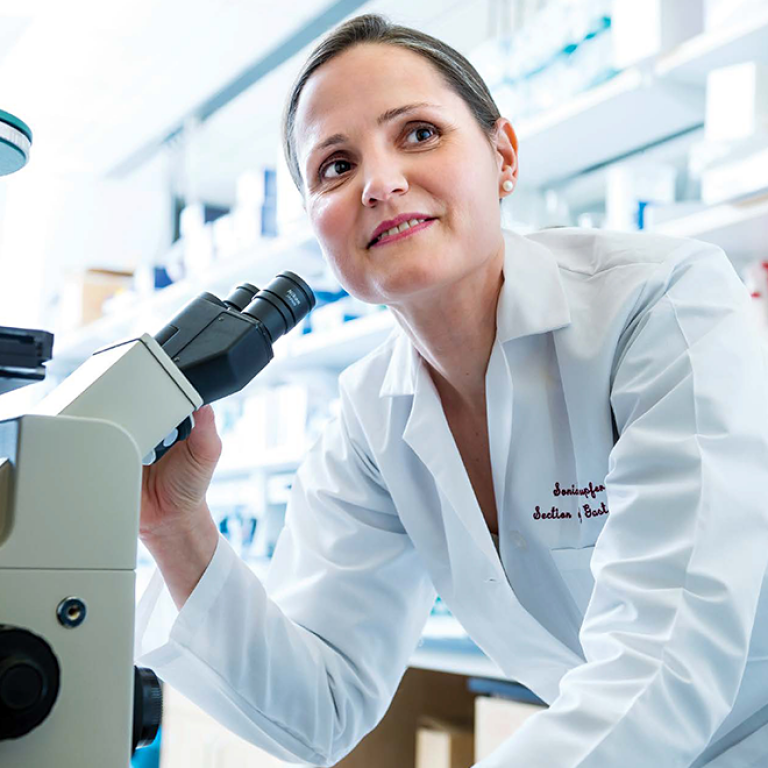
Nancy B. Schwartz, PhD, a pioneering scientist, mentor, and nationally recognized leader in graduate and postdoctoral education who spent more than five decades at the University of Chicago, died August 28, 2026, at age 82.
Schwartz was Professor of Pediatrics, Professor of Biochemistry and Molecular Biology, and Associate Dean of Basic Science, Postdoctoral Affairs. Her career spanned fundamental research into the biology of cartilage and the nervous system, as well as decades of work to strengthen the training of scientists and expand opportunities for those historically underrepresented in science.
“Nancy was a great scientist whose influence reached far beyond her own research,” said Mark E. Anderson, MD, PhD, Dean of the Biological Sciences Division, Dean of the Pritzker School of Medicine, and Executive Vice President for Medical Affairs. “She understood that the strength of science depends not only on the discoveries we make, but on the people we cultivate to make those discoveries. Her commitment to mentorship, opportunity, and scientific excellence will continue to shape our community for generations.”
Schwartz joined the University of Chicago in 1971 after training as a chemist at the University of Pittsburgh. She came to Chicago at a time when women faced significant barriers in academic science and began her career in the Department of Pediatrics, where she studied proteoglycans, complex molecules in the extracellular matrix that help shape how cells develop and function.
Her research grew into a distinguished body of work spanning nearly five decades. Schwartz became an authority on proteoglycan biology, studying how these molecules are synthesized, regulated, and processed and how defects in their production contribute to skeletal disorders. Her work included studies of cartilage and skeletal development and the genetic and molecular mechanisms underlying diseases involving proteoglycans.
Her research later expanded into the nervous system. Schwartz and her collaborators investigated the roles of proteoglycans in brain development, including their contributions to neural development and organization, and eventually extended that work into studies of neurological disease. Over the course of her career, she helped illuminate fundamental connections between extracellular matrix biology, development, and disease.
In 2006, Schwartz became Director of the Kennedy Intellectual and Developmental Disabilities Research Center at the University of Chicago, bringing together her scientific expertise and longstanding commitment to research that could improve understanding of developmental disorders.
Training and mentoring scientists
Schwartz devoted much of her career to strengthening the training and mentorship of scientists, expanding opportunities for students and researchers historically underrepresented in science, and creating pathways into scientific careers.
In 1991, Schwartz became the first woman to serve as dean of graduate affairs in the Biological Sciences Division. She recognized early that exceptional mentorship and training were essential to a strong scientific community and began leading national efforts to broaden access to graduate education.
Several years later, she helped establish the Association of American Medical Colleges’ Group on Research, Education, and Training (GREAT), a national community focused on graduate education and the experiences of trainees and postdoctoral scholars. She chaired GREAT subcommittees examining diversity in graduate education and the experiences of postdoctoral researchers.
“Nancy saw the entire continuum of scientific training and understood how important it was to create opportunity at every stage,” said T. Conrad Gilliam, PhD, Vice Dean for Basic Science. “She was an advocate for students, postdoctoral scholars, and early-career scientists long before these issues received the attention they do today. She didn’t simply talk about the need for change — she built programs and communities that made that change possible.”
Schwartz was particularly influential in advancing the cause of postdoctoral scholars. At the University of Chicago, she helped establish one of the first postdoctoral associations and went on to serve on the founding advisory board of the National Postdoctoral Association. She understood the critical role postdoctoral training plays in preparing the next generation of scientists and spent more than two decades working to strengthen that experience.
Making an impact nationally
Her influence reached across the scientific community. Schwartz helped shape national programs supporting undergraduate and post-baccalaureate researchers, contributed to organizations working to improve scientific training and mentorship, and worked with the National Institutes of Health to develop and sustain programs designed to broaden participation in biomedical research.
At UChicago, she directed five simultaneous NIH training grants, including one that was continuously funded for 41 years. Her programs included the Postbaccalaureate Research Education Program, the Initiative for Maximizing Student Development, the Neuroscience Early Stage Scientist Training Program, the National Research Mentoring Network, and the Growth, Development, and Disabilities Training Program.
Through those programs, Schwartz created opportunities for aspiring scientists at multiple stages of their careers, from students considering research to postdoctoral scholars preparing for faculty positions. She remained deeply engaged in this work throughout her career, continuing to publish on scientific training, mentorship, and the experiences of postdoctoral scholars.
Most recently, Schwartz and her former trainee, Emina Stojkovic, PhD, received an NIH Institutional Research and Academic Career Development Award supporting postdoctoral training that combines research with mentored teaching at the University of Chicago, Northeastern Illinois University, and Chicago State University.
That impact was reflected in the recognition Schwartz received throughout her career. She was honored with the National Postdoctoral Association’s Distinguished Service Award and the University of Chicago Faculty Diversity Leadership Award, among other distinctions.
“Nancy was a trailblazer, a devoted mentor, and an extraordinary colleague,” said John M. Cunningham, MD, Chair of the Department of Pediatrics and George M. Eisenberg Professor. “The generations of scientists she encouraged, supported, and helped launch are perhaps the clearest measure of her lasting impact.”
Information about memorial services and other arrangements is pending.